Implementing Wealth Management on Salesforce Financial Services Cloud: A Technical Architecture Guide
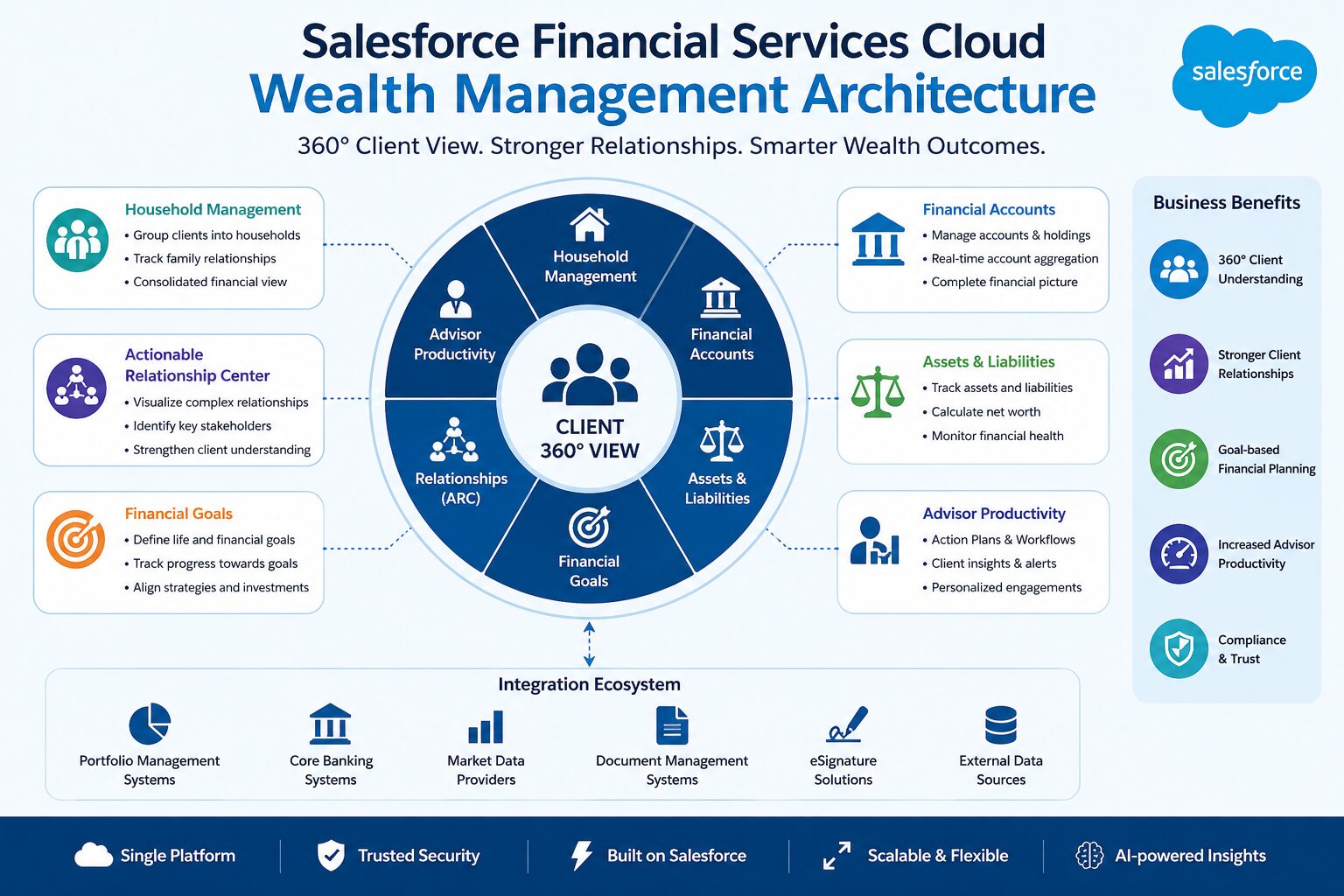
Financial institutions and wealth management firms need more than a traditional CRM. Advisors must understand family relationships, financial goals, investment portfolios, liabilities, trusts, and external stakeholders such as attorneys, accountants, and trustees. Salesforce Financial Services Cloud (FSC) provides a purpose-built data model that helps organizations create a complete wealth management platform on top of Salesforce.
This article explains the technical architecture behind Wealth Management in Salesforce Financial Services Cloud and how implementation teams can build a scalable solution using standard FSC capabilities, automation, integrations, and reporting.
Why Wealth Management Requires a Specialized CRM
Traditional CRM systems focus on individual customers. Wealth management firms, however, manage relationships across entire households and financial networks.
A typical wealth management advisor needs visibility into:
- Clients and family members
- Trusts and business entities
- Investment accounts
- Insurance policies
- Financial goals
- Assets and liabilities
- External advisors and attorneys
- Client service activities
Financial Services Cloud addresses these requirements through specialized objects and relationship models designed specifically for financial institutions.
Core Wealth Management Data Model
Before implementation begins, it is important to understand the FSC data architecture.
1. Person Accounts
Individual clients are stored as Person Accounts.
Examples:
- John Smith
- Mary Smith
- Robert Smith
Each Person Account stores:
- Personal information
- Risk profile
- KYC details
- Contact preferences
- Financial objectives
Person Accounts act as the foundation of the client record.
2. Households
One of the most powerful FSC features is Household Management.
Instead of viewing clients independently, FSC groups related individuals into households.
Example:
Smith Household
Members:
- John Smith (Primary Member)
- Mary Smith (Spouse)
- Emma Smith (Child)
The household becomes a consolidated financial relationship where advisors can analyze:
- Total assets under management
- Household net worth
- Combined liabilities
- Shared financial goals
Households are implemented using Group Membership and Party Relationship Group architecture within FSC.
Technical Relationship Architecture
A major challenge in wealth management is representing real-world relationships.
FSC solves this using relationship objects.
Account Contact Relationship
Used to define membership within households.
Examples:
| Household | Member | Role |
|---|---|---|
| Smith Household | John Smith | Primary Member |
| Smith Household | Mary Smith | Spouse |
| Smith Household | Emma Smith | Child |
Contact Contact Relationship
Used to model personal relationships.
Examples:
- Spouse
- Parent
- Child
- Attorney
- Trustee
This architecture enables advisors to understand the complete client ecosystem.
Financial Account Management
Financial Accounts represent the products owned by a client.
Examples include:
- Savings Accounts
- Brokerage Accounts
- Retirement Accounts
- Insurance Policies
- Loans
- Mortgage Accounts
Standard FSC Objects
- Financial Account
- Financial Account Role
- Financial Holding
- Financial Transaction
Example:
John Smith owns:
- Investment Account = ₹50,00,000
- Retirement Account = ₹20,00,000
- Savings Account = ₹5,00,000
These accounts can automatically roll up to the household level to provide a consolidated financial picture.
Asset and Liability Tracking
A complete wealth management solution must track both sides of the balance sheet.
Assets
Examples:
- Real Estate
- Mutual Funds
- Stocks
- Fixed Deposits
- Retirement Funds
Liabilities
Examples:
- Home Loans
- Personal Loans
- Credit Card Debt
FSC supports rollups that help advisors calculate:
Net Worth =
Total Assets - Total Liabilities
These values can be displayed on Household records, dashboards, and advisor workspaces.
Financial Goal Management
Goals are one of the most important components of modern wealth management.
Examples:
- Retirement Planning
- Child Education Planning
- Wealth Preservation
- Estate Planning
- Vacation Home Purchase
A Financial Goal record can contain:
- Goal Type
- Target Amount
- Target Date
- Current Progress
- Associated Accounts
Example:
| Goal | Target Amount |
|---|---|
| Retirement | ₹5 Crore |
| Child Education | ₹50 Lakh |
Advisors can monitor progress and trigger proactive engagement when goals are off track.
Visualizing Relationships with ARC
The Actionable Relationship Center (ARC) is one of FSC’s most powerful capabilities.
ARC provides a visual relationship graph that displays:
- Clients
- Family members
- Households
- Trusts
- Businesses
- Attorneys
- Financial Accounts
Instead of opening multiple records, advisors can visually explore relationships through an interactive graph.
Typical use cases include:
- Estate planning
- Multi-generational wealth transfers
- Complex family structures
- Trust management
ARC is configured by adding the Relationship Graph component to Lightning Record Pages.
Automating Client Onboarding
New client onboarding often involves multiple departments.
Common activities include:
- KYC verification
- AML checks
- Document collection
- Risk profiling
- Account opening
- Advisor assignment
Financial Services Cloud provides Action Plans to automate these processes.
Example Action Plan
Client Onboarding

Step 1: Collect Documents
Step 2: Verify Identity
Step 3: Risk Assessment
Step 4: Open Accounts
Step 5: Create Financial Plan
Step 6: Schedule Advisor Meeting
Each task can be assigned automatically to different users and tracked through completion.
Integrating Wealth Management Systems
Most firms already use portfolio management and core banking platforms.
A typical integration architecture looks like:
Portfolio System
        |
        v
 MuleSoft / API Layer
        |
        v
Financial Services Cloud
        |
        +---- Service Cloud
        |
        +---- Experience Cloud
        |
        +---- Data Cloud
Common integrations include:
- Portfolio Management Systems
- Core Banking Systems
- Custodian Platforms
- Market Data Providers
- Risk Assessment Tools
- Document Management Systems
- E-Signature Solutions
Recommended integration patterns:
- Platform Events
- Change Data Capture
- REST APIs
- MuleSoft APIs
- Scheduled ETL Jobs
Advisor Dashboards and Reporting
A successful wealth management implementation should provide advisor-focused dashboards.
Key KPIs include:
Client Metrics
- Total Clients
- New Clients
- High-Net-Worth Clients
Financial Metrics
- Assets Under Management (AUM)
- Household Net Worth
- Revenue Per Advisor
Service Metrics
- Open Cases
- SLA Compliance
- Client Satisfaction Score
Goal Metrics
- Goals Achieved
- Goals At Risk
- Retirement Readiness Score
Using CRM Analytics or standard Salesforce reports, advisors can receive real-time insights into their client portfolios.
Recommended Automation Architecture
For enterprise implementations, the following automation strategy works well:
Flow
Use Salesforce Flow for:
- Household creation
- Goal creation
- Advisor assignment
- Financial account rollups
Apex
Use Apex for:
- Complex calculations
- Net worth computation
- External integrations
- Portfolio aggregation
Platform Events
Use Platform Events for:
- Real-time portfolio updates
- Market alerts
- External account synchronization
Best Practices for FSC Wealth Management Implementations
- Use standard FSC objects wherever possible.
- Avoid replacing the FSC relationship model with custom objects.
- Leverage Household rollups instead of custom aggregation logic.
- Implement Action Plans for repeatable advisory processes.
- Use ARC for relationship visualization.
- Design integrations around APIs and Platform Events.
- Build advisor-centric dashboards focused on AUM and client goals.
- Keep compliance, audit history, and consent management as part of the initial design.
Conclusion
Salesforce Financial Services Cloud provides a comprehensive foundation for wealth management by combining household management, relationship intelligence, financial accounts, goal tracking, advisor workflows, and automation into a single platform. Through Person Accounts, Households, Financial Accounts, ARC visualization, and Action Plans, organizations can create a true 360-degree client view while delivering personalized financial advice at scale.
For Salesforce implementation partners, the real value lies in extending these standard FSC capabilities with integrations, automation, analytics, and AI-driven insights to create a modern digital wealth management experience.