Why Modern Enterprises Are Moving from Salesforce CPQ to Revenue Cloud
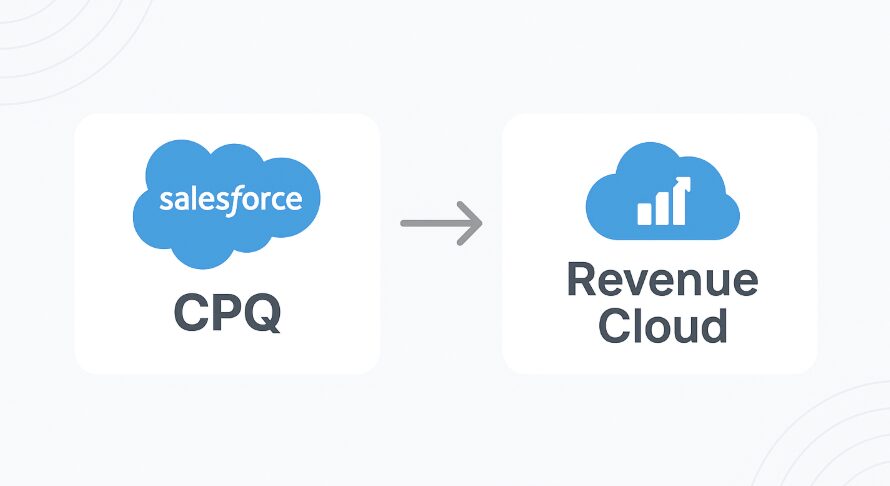
- Revenue operations are changing fast. Buyers expect seamless digital experiences, sales teams want automation, and finance leaders push for predictability and accuracy. Salesforce CPQ has served organizations well for years—but today, Revenue Cloud offers a more unified, scalable, and automation-first framework that better matches how modern companies buy, sell, and grow.
If your business is still running on standalone Salesforce CPQ, here’s why now is the right time to transition to Revenue Cloud.
1. A Unified Revenue Architecture (Not Just CPQ Functionality)
Salesforce CPQ was built to configure products, price deals, and generate quotes. Revenue Cloud expands that into a full revenue lifecycle, providing:
- Lead → Cash → Renewal → Expansion in one system
- Native integration with Subscription Management
- Alignment between Sales, Finance, Support, and Operations
- A single source of truth for pricing, contracts, and entitlements
This unified architecture eliminates the traditional patchwork of tools needed to handle recurring revenue, amendments, renewals, and usage-based billing.
Result: fewer integrations, fewer data sync issues, and more accurate revenue reporting.
2. Subscription Management Is Now Core to Growth
Today’s businesses are not selling one-time deals—they operate on:
- Monthly/annual subscriptions
- Usage-based pricing
- Tiered packages
- Hybrid models (product + services + subscription)
Salesforce CPQ can manage subscription products, but Revenue Cloud’s Subscription Management engine is designed for this model at scale:
- Automated renewals
- Consumption-based rating
- Mid-term amendments
- Cohort tracking & revenue forecasting
If your business is subscription-driven, Revenue Cloud doesn’t just help you quote—it helps you grow and retain revenue.
3. Native Data Model Removes the Mismatched CPQ Objects
Traditional CPQ relies on a series of heavily customized objects and extensions:
- Quote Line Groups
- Complex Price Rules
- Custom lookup dependencies
- Separate Subscription objects
Revenue Cloud replaces many CPQ customizations with a simplified and standardized revenue data model used across Salesforce.
This reduces:
- Technical debt
- Maintenance cost
- Upgrade complexity
- Risk of configuration breaks
Architecturally, this future-proofs your org and aligns it with Salesforce’s long-term product roadmap.
4. Automation That Eliminates Manual Handoffs
Typical CPQ → Billing → Finance processes involve friction:
❌ Manual invoice generation
❌ Finance teams reconciling subscription changes
❌ Manual renewal tracking
❌ Custom flows to handle amendments
Revenue Cloud delivers automated, event-driven, and rule-based processes:
- Automatic invoicing
- Real-time contract updates
- Revenue schedules
- Automated renewals
- Built-in compliance with ASC 606 & IFRS 15
Your entire revenue operations pipeline becomes touchless.
5. Better Integrations with Core Salesforce Clouds
Revenue Cloud is architected to work seamlessly with:
- Sales Cloud
- Service Cloud
- Experience Cloud
- Marketing Cloud Account Engagement
- B2B Commerce
- Data Cloud (formerly Genie)
With CPQ, much of this required integration mapping and custom middleware.
With Revenue Cloud, these integrations are native, especially with Data Cloud powering:
- Real-time customer segmentation
- Unified account insights
- Personalized renewal journeys
This level of unification simply wasn’t possible with standalone CPQ.
6. Improved Performance and Scalability
CPQ struggles as orgs grow:
⚠ Large product catalogs
⚠ Complex bundle rules
⚠ Heavy calculations
⚠ Multi-currency logic
⚠ High transaction volume
Revenue Cloud uses newer, optimized frameworks built to support:
- Large SKUs
- High-volume quoting
- Multi-entity / multi-currency orgs
- Enterprise-grade subscription logic
For scaling businesses, this means faster quote times and stable performance.
7. Future Salesforce Investments Are Going Into Revenue Cloud
Salesforce has clearly shifted its focus. Recent releases show:
- Revenue Cloud-first innovations
- AI-driven pricing recommendations
- Automated renewals
- Better usage billing
- Native subscription analytics
CPQ continues to receive support, but not innovation.
Companies that move now stay ahead of the curve instead of scrambling in two years when CPQ becomes a legacy solution.
8. AI + Revenue Cloud = Intelligent Selling
Revenue Cloud is built to integrate with:
- Einstein GPT for Revenue
- Predictive pricing
- Renewal risk scoring
- Recommended add-ons & upsells
- AI-powered contract analysis
AI features for CPQ are limited and will not expand significantly.
Switching to Revenue Cloud unlocks AI-powered RevOps across the entire lifecycle.
Final Thoughts: The Move From CPQ to Revenue Cloud Is Not Optional—It’s Strategic
Companies adopting Revenue Cloud are seeing:
✅ 20–40% faster quote cycles
✅ 30%+ reduction in revenue leakage
✅ 2× improvement in renewal efficiency
✅ Faster close-to-cash processes
✅ A unified revenue architecture to support future growth
If your sales, finance, operations, or customer teams struggle with fragmented tools or complex CPQ workflows, moving to Revenue Cloud is the right step.
Want Help Migrating from Salesforce CPQ to Revenue Cloud?
Tenetizer specializes in:
- CPQ → Revenue Cloud migrations
- Subscription Management implementations
- Product model redesign
- End-to-end RevOps architecture
- Billing & finance automation
- AI-enhanced CPQ and revenue workflows
📩 Contact us: contact@1cloud.com
Other posts